


Seven steps leading to knowledge: in capsules reflecting the “First Renaissance”
🔴 The Legacy of Eastern Thinkers – In a Modern Exhibition
🔴 The Awakening of Thought, Knowledge, and Faith
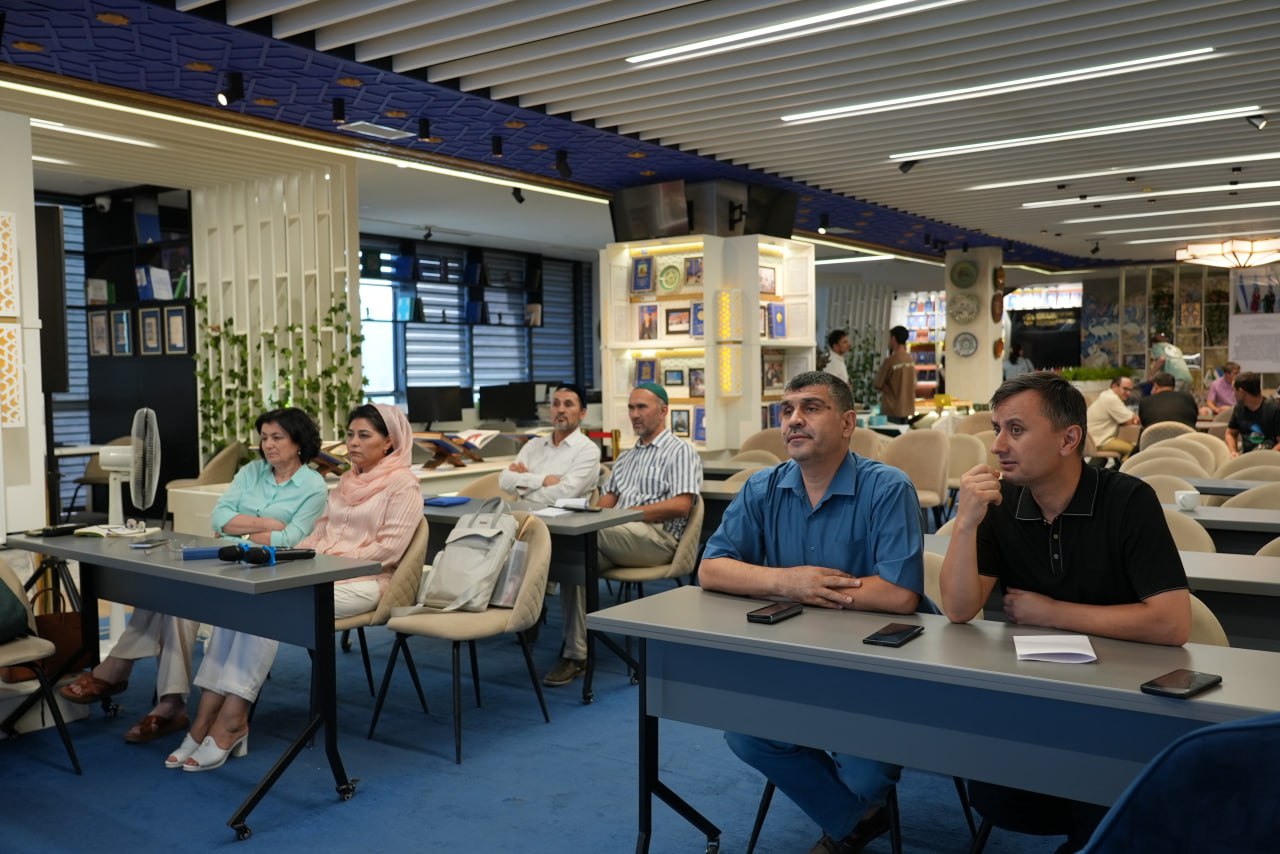
A new round of scholarly discussions was held regarding the structure and conceptual content of the exhibition dedicated to the “First Renaissance” period, planned to be housed at the Center of Islamic Civilization in Uzbekistan.
The meeting reviewed the final stage of the exhibition’s general concept, the seven thematic capsules, the exhibits to be included, visual solutions, and textual materials. The exhibition aims to highlight the scientific, philosophical, and spiritual heritage, encompassing the following key areas:
The introduction of Islam to Central Asia — This capsule will showcase exhibits such as letters written by the Prophet Muhammad (peace be upon him), enlarged copies of the Qur’an, the Kiswa (the covering of the Kaaba), and a symbolic key to the door of the Kaaba. Manuscripts and artifacts from this period will be displayed in both double-sided and single-sided showcases. Pages from the Uthmanic Mushaf will serve as one of the main visual highlights of the exhibition.
Islamic theology and Sufism — This capsule will feature the teachings related to Imam Maturidi, along with works on Sufism and kalam (Islamic theology).
Fiqh, hadith, tafsir, and sirah — The capsule will present works by great hadith scholars such as Imam Bukhari and Imam Tirmidhi, including rare manuscripts like Al-Jami’ al-Sahih and Shama’il al-Muhammadiyya.
Natural and exact sciences — This capsule will highlight the immense contributions of thinkers such as Ibn Sina (Avicenna) and al-Biruni to the development of science.
The school of Bayt al-Hikma and its legacy — The works and scientific significance of scholars like al-Khwarizmi, al-Farabi, and al-Fargani will be presented.
Social and human sciences — This section will feature materials on Turkic literature, lexicography, philosophy, and logic. Notably, facsimile editions of Yusuf Khass Hajib’s Qutadghu Bilig, Dīwān Lughāt al-Turk, and al-Zamakhshari’s Mufassal and Muqaddimat al-Adab will be on display.
The Khwarazm Ma’mun academy — Serving as the central part of the exhibition, this capsule will cover the lives and scholarly contributions of scientists such as Ibn Sina, al-Biruni, Ibn Masih, and Ibn Iskawi.
The exhibition walls will feature Qur’anic verses about knowledge, enlightenment, and ignorance including the opening verses of Surah al-Falaq alongside ornamental inscriptions dedicated to science, as well as rare artifacts brought from the Scottish collection.
The design solutions and visual concepts of the exhibition were developed in collaboration with specialists from Italy’s Magister Art company. During the discussion, relevant feedback was provided, and suggestions were made to adapt the concepts to the national mentality and historical context.
At the conclusion of the meeting, the overall concept of the exhibition was approved, and necessary recommendations were formulated for the next practical stages.
Most read

Over 100 experts from more than 20 countries of the world are in Tashkent!

President of Serbia Aleksandar Vučić visited the Islamic Civilization Center in Uzbekistan

The Center for Islamic Civilization – a global platform leading towards enlightenment
