


Historical “Post”: the prayer of Amir Temur engraved into the rock
🔴 The stone speaking of the sultanate of Amir Temur
🔴 A noble initiative launched by the Center of Islamic Civilization in Uzbekistan
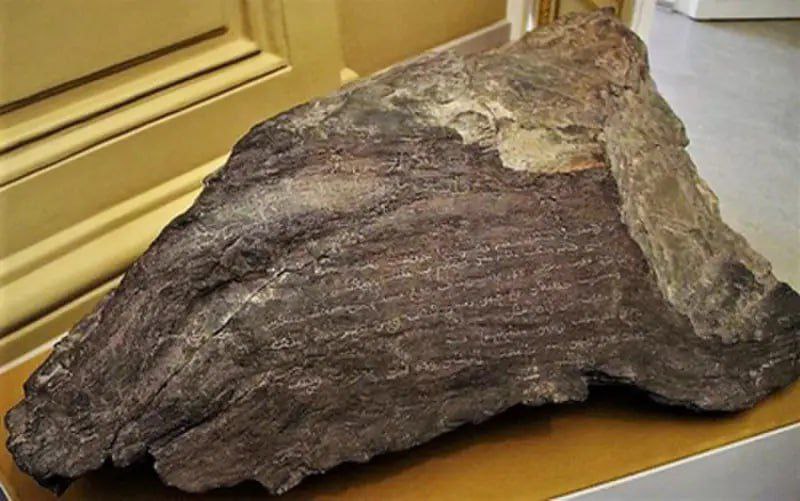
Every nation’s memory, past, and pride are reflected in its historical heritage. Among such sources, inscriptions carved into stone particularly express the spiritual world, political thinking, and moral legacy of a people in the deepest sense. One such precious monument is the “Bitik-tosh” (Inscribed Stone) dating back to the era of Amir Temur, weighing two tons. This historical artifact was discovered in present-day Kazakhstan, and currently, the Center of Islamic Civilization in Uzbekistan is working on preparing a facsimile (replica) of it.
The inscription on the rock at Ulugh Tagh
The Bitik-tosh was inscribed in April 1391 during Amir Temur’s second military campaign against Tokhtamysh Khan, in the foothills of Ulugh Tagh, located in Kazakhstan. This campaign is also mentioned in the work Temur’s Code (Temur Tuzuklari). According to legend, when Temur climbed the mountain, he experienced spiritual inspiration and had this inscription carved into the rock to commemorate the campaign. Today, this peak is known as “Altin Chokki” (“Golden Summit”).
The mystery of the discovery
In 1935, the Bitik-tosh was discovered near the Karsakbay mine in Kazakhstan’s Karaganda region by geologist K.I. Satpayev. Later, the scholar K.I. Rozhnov used a special technique to enhance the clarity of the inscription, photographed it, and sent it to the Academy of Sciences in Moscow. In 1936, a special expedition was organized under the signature of the Hermitage director I.A. Orbeli. As a result, the historic stone was taken to Leningrad and delivered to the Hermitage Museum.
The sultan’s words on the stone
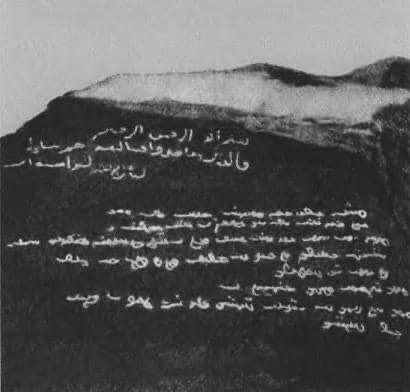 According to researchers, the inscription on the Bitik-tosh consists of 11 lines. The first three lines are written in the Arabic script, while the remaining lines are in the Uighur script. The Arabic portion contains the Basmala and several of the beautiful names of Allah. One of the lines written in Uighur script conveys the following message:
“In the year 793 of the Hijri calendar, the Year of the Sheep, the Sultan of Turan, Temur Beg, marched with an army of 300,000 for the sake of Islam against Tokhtamysh Khan. He set up this stone as a sign. May God grant justice, in shaa Allah. May God show mercy to the people and remember us in their prayers”.
This inscription is not only a record of a historical event but also a profound reflection of Amir Temur’s spiritual worldview, his loyalty to his people, and his devotion to Islamic values.
Research and inscription technique
The stone has not undergone any artificial processing. The height of the letters does not exceed 1 cm, and the depth is around 1.5–2 mm. The Uighur script is carved with precision and care, while the Arabic script appears less clear and hastily inscribed. The absence of diacritical marks has made some lines difficult to read. These observations are also noted in a scholarly article by A.P. Grigoryev, N.N. Telisin, and O.B. Frolova.
The facsimile – restoring historical justice
Currently, a facsimile of the Bitik-tosh is being prepared at the initiative of the Center of Islamic Civilization in Uzbekistan. This work is being carried out in collaboration with scholars from the State Hermitage Museum of Russia. It is considered an important step toward restoring historical justice and transmitting the legacy of Amir Temur to future generations.
History speaks through stone
The Bitik-tosh is not just an inscription it is a stone embodiment of statehood, faith, military campaigns, and spiritual heritage. Amir Temur’s inscription on the rocks of Ulugh Tagh is not only a historical record, but also a moral symbol, a vessel of national memory, and a key to understanding cultural identity.
Most read

Over 100 experts from more than 20 countries of the world are in Tashkent!

President of Serbia Aleksandar Vučić visited the Islamic Civilization Center in Uzbekistan

The Center for Islamic Civilization – a global platform leading towards enlightenment
