


Internews Pakistan: Economics of the Islamic Civilization Center
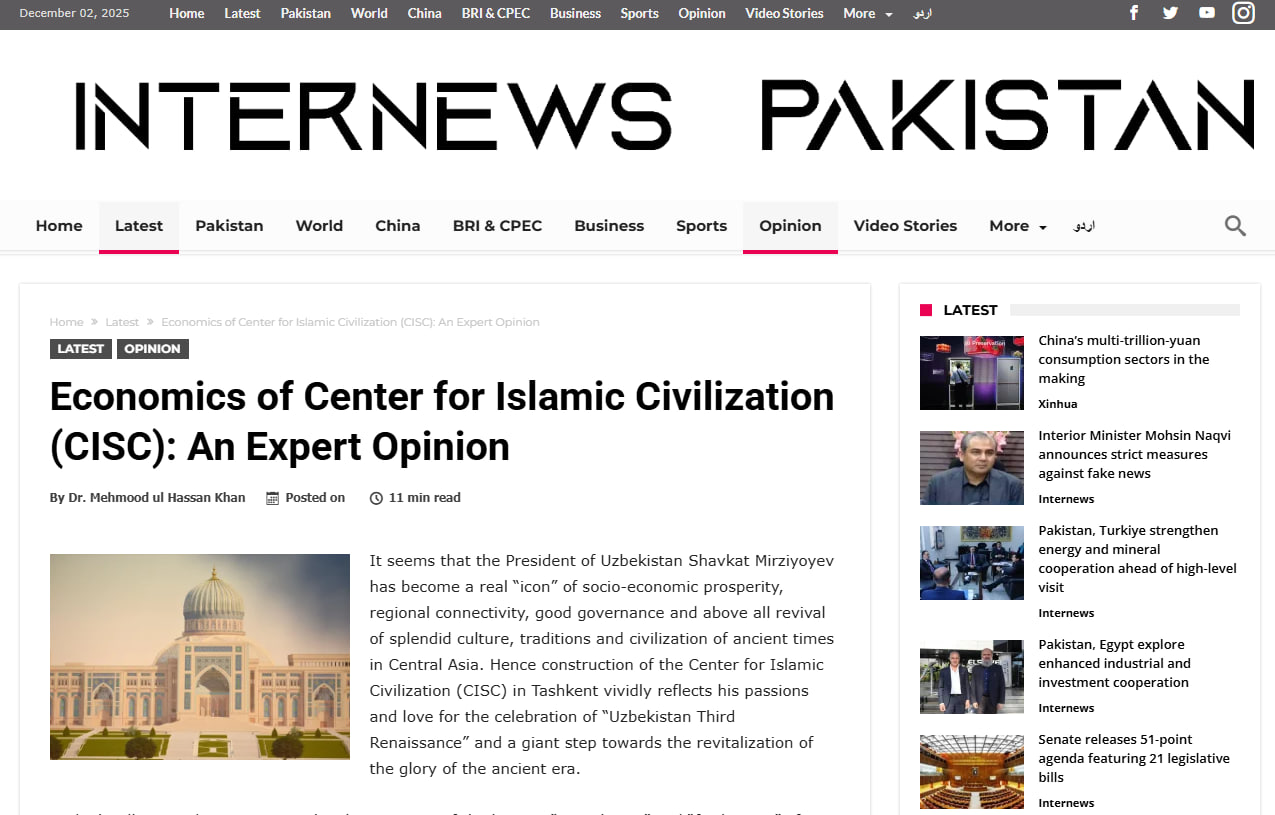
The Pakistani outlet Internews Pakistan has published an article about the Islamic Civilization Center in Uzbekistan. The article provides extensive coverage of the Center’s cultural, scientific, and educational significance, its role in integrating modern technologies with historical heritage, and its contribution to enhancing Uzbekistan’s global cultural and economic standing.
President Shavkat Mirziyoyev is recognized as an influential and ambitious leader in Central Asia’s socio-economic development, regional cooperation, good governance, and the revival of ancient culture, traditions, and civilization. In this context, the Islamic Civilization Center built in Tashkent is described as the foundation of “Uzbekistan’s Third Renaissance” and as a vivid reflection of state policies and strategic initiatives aimed at restoring the grandeur of ancient eras.
President Mirziyoyev plays a major role in linking the greatness of the past with contemporary development through innovation, modernization, openness, integration, and efficiency. Therefore, the Center is regarded as an institution tasked with advancing humanity, human values, knowledge, wisdom, and tolerance through dialogue, diplomacy, and development.
As an integrated model of both modern and ancient civilization, the Center serves as an effective platform for the mutually beneficial study of wisdom, ethnic diversity, trade, economics, culture, and traditions, as well as for exchange of experience. It is also seen as an important factor in transforming Uzbekistan’s ancient civilization and cultural heritage into economic value and fostering development through socio-economic integration and joint enterprises.
The economic role of the Islamic Civilization Center in Uzbekistan is significant in attracting investments to sectors such as tourism, hospitality, media cooperation, education, healthcare, civil aviation, and infrastructure development, thereby boosting the country’s international reputation.
The Center rises four times higher than the Hollywood Sign and is roughly seven times larger than the White House, making it a monumental site of great importance to economic development, social prosperity, and modern international engagement.
The Islamic Civilization Center in Uzbekistan is expected to open to the general public in March 2026, with a mission to revive and develop Uzbekistan’s historical role as a center of Islamic scholarship. It will serve as an important hub for promoting interfaith harmony, tolerance, and the revival of ancient epics and scientific heritage through modern technologies, including artificial intelligence.
More than 1,500 specialists from over 40 countries are collaborating on scientific, cultural, and futuristic projects at the Center. The Islamic Civilization Center in Uzbekistan features an “interactive learning zone” that inspires younger generations in the fields of knowledge and art through virtual and augmented reality and artificial intelligence technologies.
The library on the second floor offers access to more than 200,000 works, creating vast opportunities for international research.
The Islamic Civilization Center in Uzbekistan is more than just a museum it holds broader functions, connecting historical and cultural heritage with modern life through its cultural and educational components. It also demonstrates a commitment to secular principles and presents the traditions of Islam, Zoroastrianism, and Buddhism, as well as the golden age of science, literature, and architecture.
Throughout history, Uzbekistan was a center for interregional trade, economy, and intellectual exchange along the ancient Silk Road forming the foundation of today’s global interconnectedness. Bukhara and Samarkand served as key points along the Silk Road and were hubs of cultural and scholarly exchange.
As a modern scientific and cultural discovery, the Islamic Civilization Center in Uzbekistan has restored more than 2,000 historical artifacts through global auctions, achieving major success in preserving Uzbekistan’s ancient craftsmanship and scientific heritage.
The Center houses numerous remarkable artifacts, including the world’s oldest 7th-century Uthman Qur’an and 114 Qur’an manuscripts created by various renowned rulers and calligraphers over different centuries.
According to the author, the Islamic Civilization Center in Uzbekistan possesses “great potential” and “multifaceted benefits,” which can be further enhanced through continuous scientific research, education, and cultural activities.
The Center also serves as an ideal platform for “cultural innovation,” “intellectual creativity,” efficiency, and interfaith harmony, while at the same time playing an important role in Uzbekistan’s economy and sectors such as tourism, hospitality, and cultural diplomacy.
Most read

Over 100 experts from more than 20 countries of the world are in Tashkent!

President of Serbia Aleksandar Vučić visited the Islamic Civilization Center in Uzbekistan

The Center for Islamic Civilization – a global platform leading towards enlightenment
