


Euronews: “Central Asia and Azerbaijan: a shared cultural legacy for a shared future”
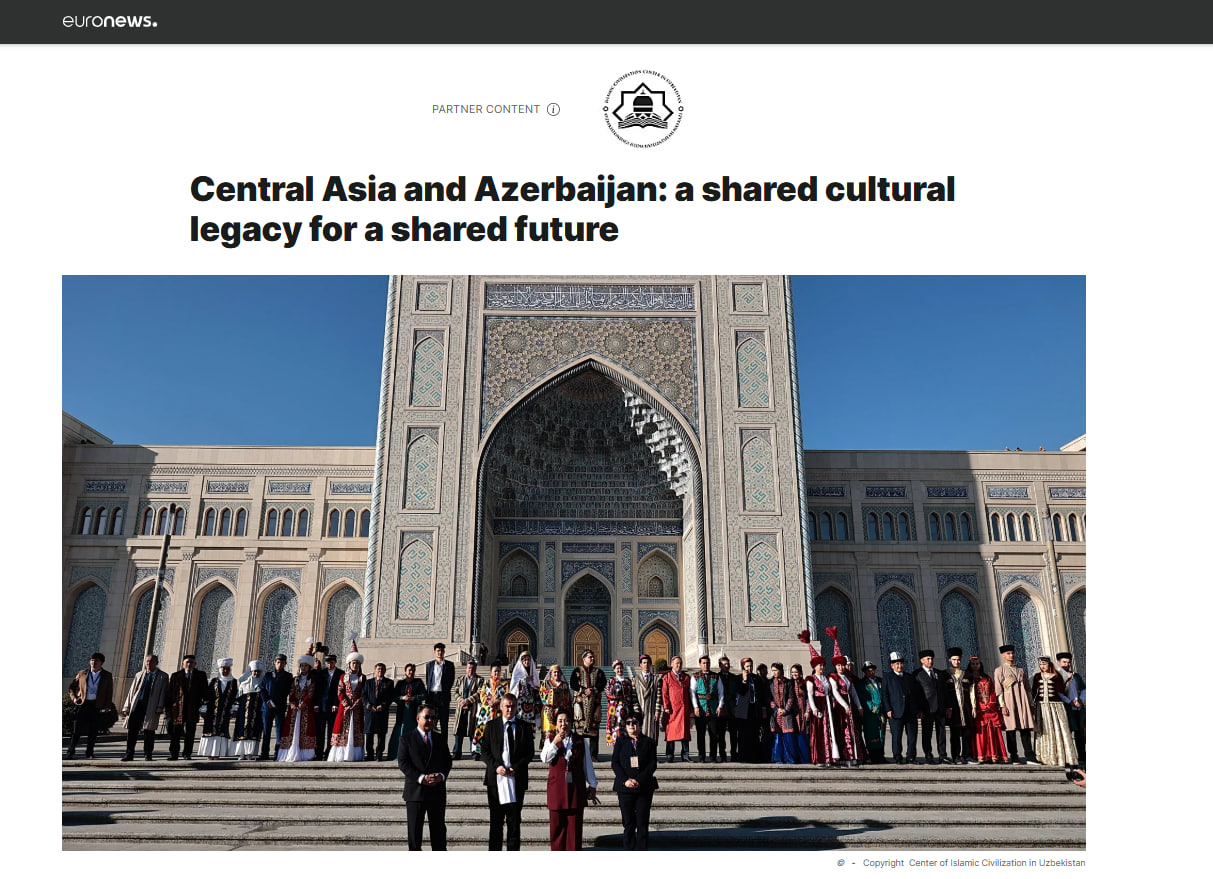
The prestigious international news agency Euronews has published an article about the shared cultural heritage of Central Asia and Azerbaijan, as well as the international congress held at the Islamic Civilization Center in Uzbekistan. The material highlights the region’s centuries-old intellectual heritage, its relevance in today’s global context, and Uzbekistan’s leading role in cultural diplomacy.
Culture is the memory of civilization. It transcends borders, survives political changes, and unites generations and nations.
This very idea formed the basis of discussions among scholars, historians, statesmen, and cultural representatives from Central Asia and Azerbaijan at the international congress “Central Asia: shared spiritual-educational heritage — shared future,” held at the Islamic Civilization Center in Uzbekistan.
Delegates gathered in Tashkent, revealing the significance of the region’s centuries-old enlightenment traditions and their importance today. This idea was officially reflected in the final declaration of the congress.
A regional identity built upon shared heritage
At a time of increasing geopolitical tensions, international disputes, and border conflicts, participants emphasized the deep cultural foundation that unites nearly 100 million people across Central Asia and Azerbaijan.
The event gained even greater significance with the installation of the Uthman Qur’an — one of the world’s oldest and most revered Qur’an manuscripts in the main hall of the center. Delegates described this moment as deeply symbolic.
In his congratulatory message delivered at the opening of the event, the President of the Republic of Uzbekistan Shavkat Mirziyoyev noted:
“In today’s extremely complex period, when conflicts and contradictions intensify in various parts of the world, our most urgent mission is to preserve peace and stability. We must approach every issue through knowledge and enlightenment, strengthen harmony among peoples, and expand dialogue between cultures and civilizations.”
Diplomatic value and cultural cooperation
President Mirziyoyev addressed his message on the eve of the Summit of Heads of State of Central Asia and Azerbaijan. In it, he called on the United Nations to support a special resolution recognizing the joint contribution of Central Asia and Azerbaijan to global education, science, and culture.
The timing added political weight to the congress, once again confirming that cultural cooperation plays a vital role in strengthening regional trust and integration. It was noted that Uzbekistan is playing a leading role in this process.
A historical contribution to world civilization
Speakers also recalled the tremendous role of Central Asia and Azerbaijan in shaping world civilization. During the Islamic Renaissance of the 8th–13th centuries, the territories of modern Central Asia and Azerbaijan were among the major centers of science and thought.
Scholars such as Beruni, Ibn Sina, Farabi, Alisher Navoi, Imam Bukhari, and Mirzo Ulugbek made groundbreaking discoveries that transformed mathematics, astronomy, philosophy, medicine, theology, and literature.
Speaking about this heritage, the Director of the Center and Chairman of WOSCU, Dr. Firdavs Abdukhalikov, told the delegates:
“Central Asia is not just a region. It is the cradle of great ideas and creativity. The initiative of the President of Uzbekistan does not only restore, preserve, and elevate the cultural-historical legacy of Uzbekistan, but that of the entire region and the Islamic world. Our Center provides all the necessary conditions to realize this grand mission.”
The Islamic Civilization Center
Construction of the Islamic Civilization Center, initiated by the President of Uzbekistan in 2017, is located next to the Hazrat Imam complex the spiritual heart of Tashkent and its opening is planned for March 2026. The Uthman Qur’an currently occupies the central place beneath a 65-meter dome, surrounded by unique artifacts reflecting the region’s scientific and artistic heritage.
The exhibitions present the history of Central Asia from ancient civilizations, through the scholars of the First and Second Islamic Renaissance, to modern reforms in education, science, and research. Delegates described the center as a vast cultural-educational space where history and modern identity merge, giving rise to new meanings and ideas.
Unity beyond borders
Throughout the congress, this spirit of unity was strongly felt. Representatives of Azerbaijan, Kazakhstan, Kyrgyzstan, Tajikistan, Turkmenistan, and Uzbekistan spoke about the deep cultural ties established long before modern political borders.
The congress also highlighted Uzbekistan’s wide-ranging efforts to revive scientific and educational traditions in the region. In recent years, hundreds of new schools have been opened, the number of higher education institutions has doubled, and new research centers dedicated to scholars such as Imam Bukhari and Imam Maturidi have been established.
Shared spiritual heritage — towards a shared future
The unification of Central Asia and Azerbaijan around the spiritual center revived in Uzbekistan not only reaffirms their shared cultural legacy but also creates a new platform for long-term cooperation and regional development.
Most read

Over 100 experts from more than 20 countries of the world are in Tashkent!

President of Serbia Aleksandar Vučić visited the Islamic Civilization Center in Uzbekistan

The Center for Islamic Civilization – a global platform leading towards enlightenment
