


STAR: “The rising horizon of the New Uzbekistan”
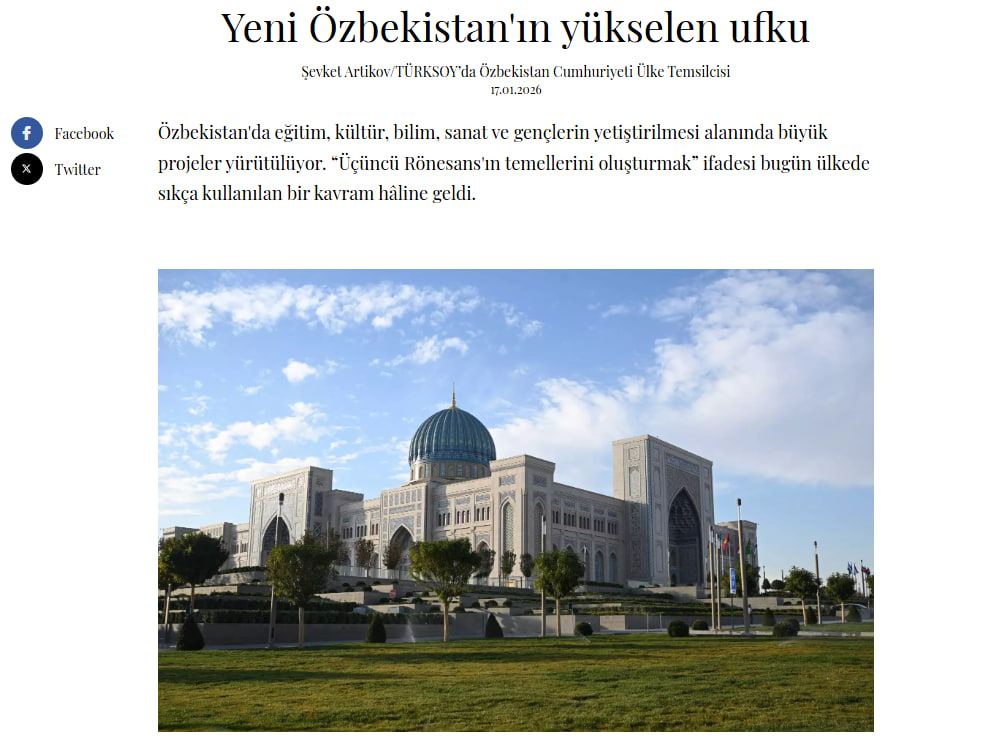
An article titled “The Rising Horizon of the New Uzbekistan” by Shavkat Ortiqov, Uzbekistan’s representative to TURKSOY, has been published in Turkey’s reputable online newspaper STAR. The article discusses the large-scale reforms being implemented in recent years in the cultural and educational spheres under the leadership of President Shavkat Mirziyoyev, important initiatives aimed at preserving cultural heritage and their significance, as well as the processes related to the establishment and activities of a major and unique project realized in Uzbekistan — the Islamic Civilization Center.
In Uzbekistan, large-scale projects are being carried out in the fields of education, culture, science, art, and youth development. Today, the phrase “creating the foundation of the Third Renaissance” has become a widely used and significant concept in the country.
Shavkat Ortiqov / Representative of the Republic of Uzbekistan to TURKSOY
With Shavkat Mirziyoyev assuming office as President of Uzbekistan in 2016, not only was political life renewed, but a period of profound transformation also began in relations between the people and the state, as well as in the cultural and spiritual environment.
During this process, Uzbekistan’s relations with Turkey, Azerbaijan, Turkmenistan, and all Turkic states rose to a new level. Cooperation with the Organization of Turkic States, TURKSOY, and other international institutions was strengthened.
Although there are many economically developed countries in the world, spirituality, morality, and cultural values are not equally appreciated everywhere. Uzbekistan, however, has realized that development is not only linked to economic reforms, but also to cultural and spiritual progress. Therefore, major projects are being implemented in the fields of education, culture, science, art, and youth upbringing. The concept of “creating the foundation of the Third Renaissance” has become an important spiritual principle in the life of the country.
Throughout history, the land of Uzbekistan has been the cradle of two great eras of enlightenment the First and Second Renaissances. Figures such as al-Khwarizmi, al-Farghani, al-Biruni, Ibn Sina, al-Zamakhshari, Imam Bukhari, Imam Tirmidhi, Imam Maturidi, al-Marghinani, al-Nasafi, Ulugh Beg, Alisher Navoi, and Babur are great personalities who guided humanity’s history.
However, over the centuries, the people endured severe trials and struggled to preserve their culture and spirituality. The Jadid movement of the early twentieth century was a symbol of this struggle. Through education, science, art, and the press, the Jadids sought to elevate public consciousness and attain freedom; many of them sacrificed their lives on this path.
Today, the dreams of the Jadids that were left unfulfilled are being revived.
A worthy study of Islamic enlightenment…
Previously, foreign guests were introduced to museums and historic cities in Uzbekistan, but there was no single place that comprehensively presented three thousand years of statehood history. The Islamic Civilization Center, whose construction began on the basis of a presidential decree dated June 23, 2017, was implemented as a mega project that filled this gap. It became an important step toward preserving cultural heritage, supporting scientific research, and creating modern cultural and educational spaces.
In his speech at the 72nd session of the UN General Assembly, President Mirziyoyev emphasized the importance of conveying the humanistic, peace-loving, and enlightened values of Islam to the entire world. He also underlined the role of great scholars from Uzbekistan in presenting the bright image of Islam to humanity.
On the day of Ramadan Eid in 2018, the foundation stone of the Center was laid. At the ceremony, the President stated: “The purpose of establishing this Center is to study Islamic enlightenment in a worthy manner and to convey the great heritage of our ancestors to our people and the world community.”
Over eight years, the construction of the massive building and its infrastructure was carried out. The President personally reviewed the project ten times, and more than ten decisions and decrees were adopted to improve it.
The building, measuring 161 meters in length and 118 meters in width, was constructed as a three-story structure in harmony with ancient architectural traditions and national ornamentation. The portals reach a height of 34 meters, while the main central dome rises to 65 meters. The heart of the Center is the Holy Qur’an Hall, where a rare copy of one of the oldest sacred relics of the Islamic world - the Uthman Mushaf - is displayed. In addition, sacred manuscripts from the Samanid, Karakhanid, Khwarazmshah, and Timurid periods, Turkic-language translations, and rare handwritten Qur’an copies are also exhibited.
In recent years, Uzbekistan has implemented a comprehensive program to repatriate its historical heritage preserved in world museums and private collections.
A special working group studied Uzbek heritage in more than one hundred libraries and museums across Saudi Arabia, Italy, Spain, France, Germany, Switzerland, Turkey, the United Kingdom, Russia, Malaysia, Pakistan, Kuwait, and Iran. More than 580 rare exhibits were acquired from the Sotheby’s and Christie’s auction houses and private collections.
In May 2025, 35 Seljuk-period artifacts were also returned to Uzbekistan through a Christie’s auction. Timurid-era exhibits are generating great interest in global antique markets. In particular, a single page of the “Mi‘rajnama” from the period of Mirzo Shahrukh was valued very highly.
Uzbekistan has also repatriated part of a massive Qur’an copy commissioned by Amir Temur, Ibn Sina’s “Kitab al-Shifa,” as well as manuscripts and miniatures from the Mughal period.
Knowledge, art, and faith in one place
At the Center, the historical path from pre-Islamic civilizations through the First Renaissance, the Second Renaissance, and up to the New Uzbekistan period is presented as a unified whole.
Chess pieces found in Afrasiyab and Dalvarzintepa indicate that Uzbekistan is one of the regions where chess originated. A 3,300-year-old flute discovered in the village of Muminobod in Urgut proves that the art of music on this land has a tradition spanning several millennia.
Libraries, workshops, and international cooperation
On the third floor of the Center, there is a modern library containing 350,000 printed books and 5 million digital resources. Offices of UNESCO, TURKSOY, ICESCO, IRCICA, and many scientific centers from around the world also operate here. Special interactive zones have been created for children.
At the First Scholars’ Forum held in 2023, nearly 500 specialists participated and more than 600 proposals were reviewed. Subsequently, the established Scientific Council held nearly 40 meetings and considered more than 200 issues.
In August 2024, the international congress “The Heritage of Great Ancestors — the Foundation of the Third Renaissance,” held in Tashkent and Samarkand, brought together 350 scholars from more than 40 countries. A total of 170 projects and 200 proposals were accepted.
The Center has hosted UN Secretary-General António Guterres, TURKSOY Secretary General Sultan Raev, ICESCO Director-General Salim al-Malik, IRCICA Director-General Mahmud Erol Kılıç, and other prominent figures of the Islamic world. President Mirziyoyev announced at the 80th session of the UN that the Islamic Civilization Center would open soon.
The Center also hosted the major international congress “Central Asia: Common Spiritual and Educational Heritage — Common Future” on November 13–15. In his congratulatory message at the opening of the event, President Shavkat Mirziyoyev outlined the Center’s key future objectives.
President Mirziyoyev emphasized:
“Exchanging experience and views with our international partners on preserving spiritual and educational heritage, and identifying priority areas for joint research and projects, will remain in our constant focus. With your participation, preparing a draft special resolution of the UN General Assembly on the contribution of Islamic civilization to global enlightenment, development, and science will be an important practical step. Next year, we plan to hold a special event at the UN Headquarters dedicated to the rich scholarly and educational heritage of our ancestors. We must jointly carry out effective work to strengthen Central Asia’s standing as an ancient center of science and enlightenment.”
Everyone who visits the Islamic Civilization Center discovers the invaluable contribution of this land to world civilization and feels deep respect and admiration. This Center is not only an architectural structure, but also a cultural project that embodies the spirit, purpose, and will for renewal of the New Uzbekistan.
The Uzbek people are rightfully proud to have such a unique Center.
Most read

Over 100 experts from more than 20 countries of the world are in Tashkent!

President of Serbia Aleksandar Vučić visited the Islamic Civilization Center in Uzbekistan

The Center for Islamic Civilization – a global platform leading towards enlightenment
