


The earliest teaching on goodness and humanity: an Avestan page in Sogdian script on display
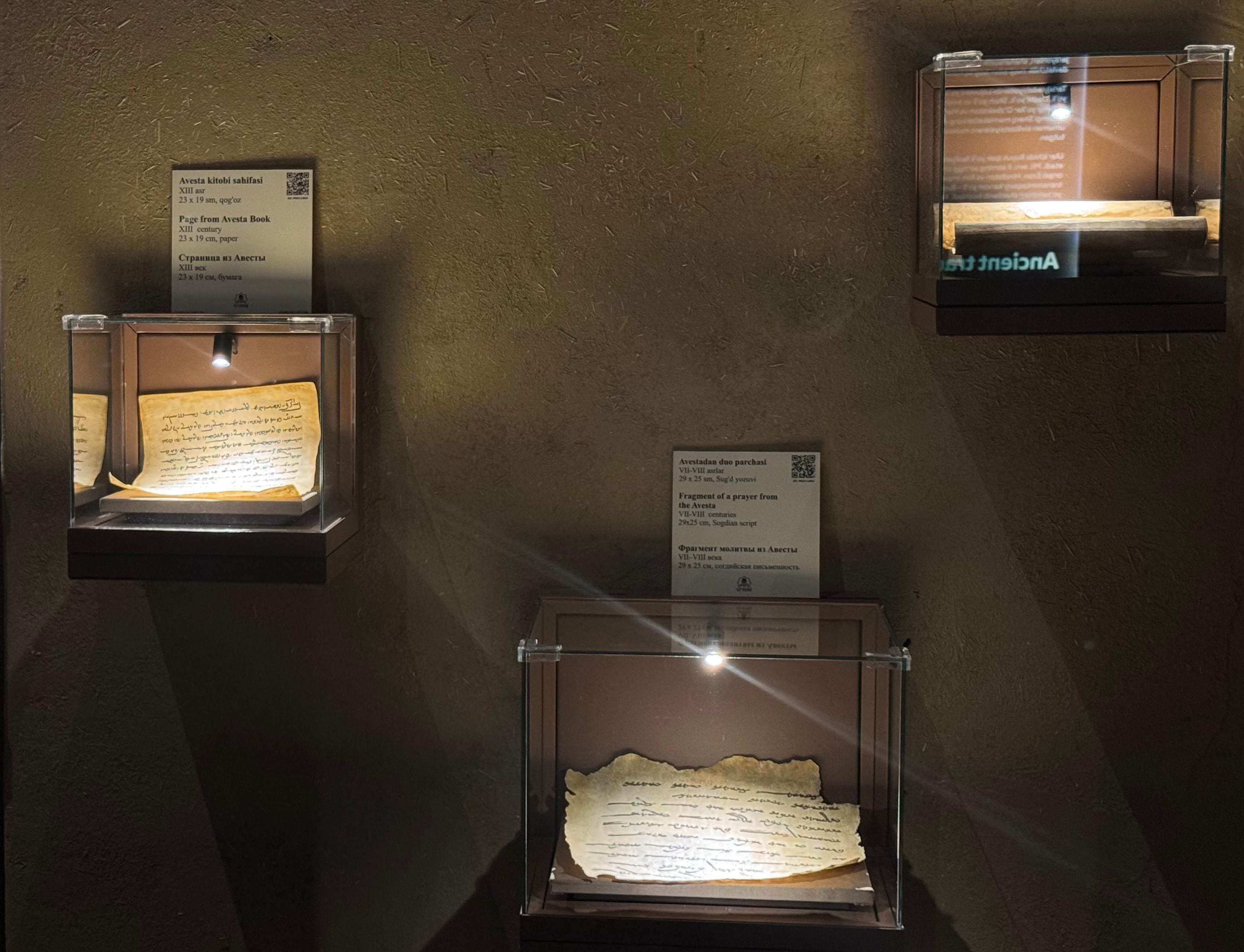
The Zoroastrian doctrine that emerged in ancient Khorezm and its sacred source the book Avesta occupy a special place in the development of world civilization. Today, this invaluable example of spiritual heritage, namely an Avesta page written in Sogdian script, is displayed in the Pre-Islamic Civilizations section of the exhibition at the Islamic Civilization Center in Uzbekistan.
The Avesta, as the sacred book of Zoroastrianism the leading religion of the Turan peoples in the pre-Islamic period is one of the most ancient monuments of humanity’s spiritual thought. It is here that the idea of a single divine creator of existence was first articulated, and the human being and their honest labor were exalted. The struggle between good and evil is interpreted as a central theme of the universe, with Ahura Mazda portrayed as the guide of goodness and Ahriman as the embodiment of evil.
The Avesta foretells the triumph of goodness and presents the human factor as the decisive force in saving the world from evil. The fundamental moral-philosophical motto of the work “Good thoughts, good words, good deeds” has not lost its significance even today as a universal human value.
The 13th-century Avesta page displayed in the Center’s exhibition clearly demonstrates how carefully this sacred text was preserved over the centuries and how highly its spiritual value was esteemed. These pages represent not only a religious text, but also the writing culture, bookmaking art, and intellectual environment of their time.
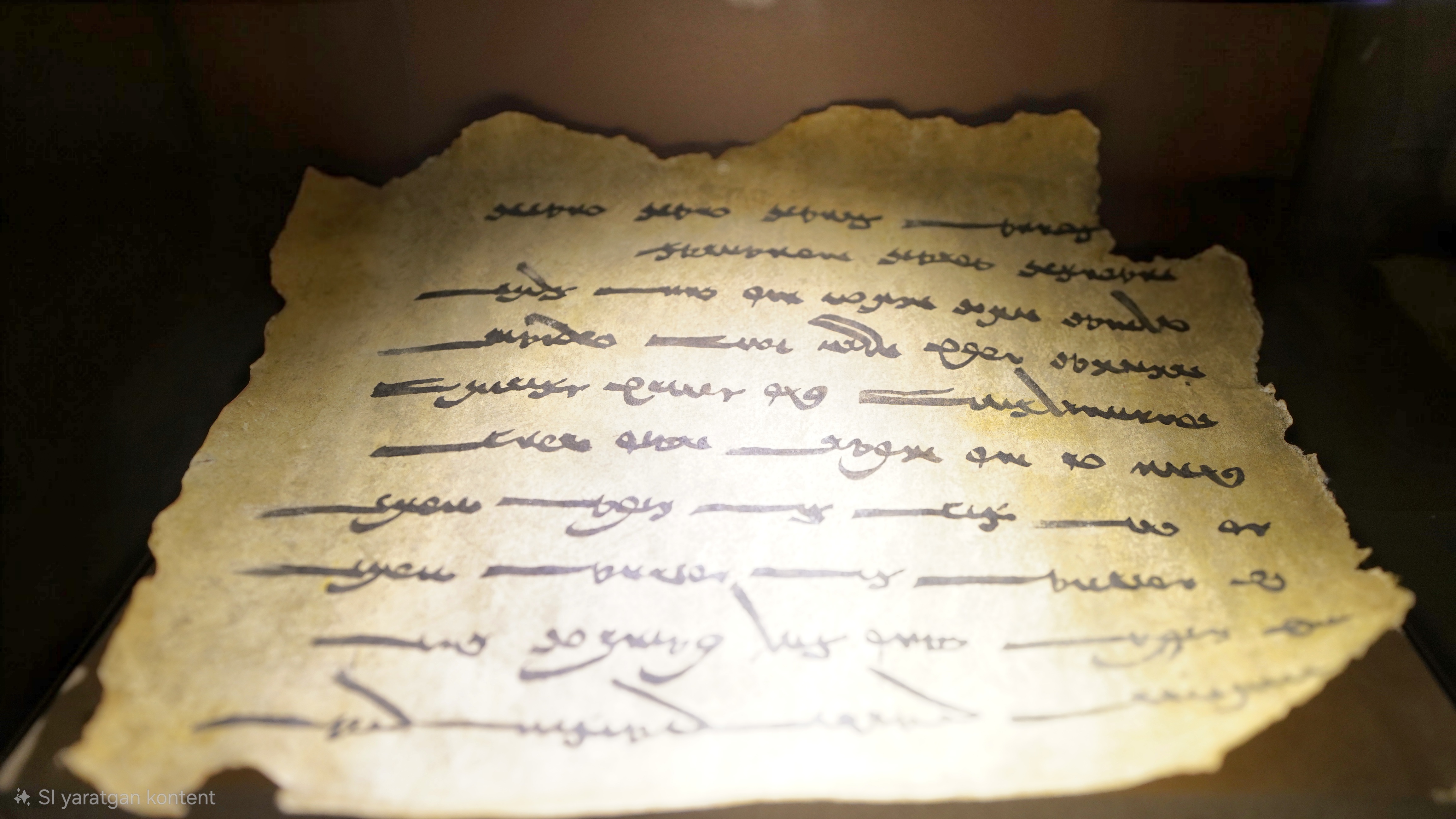
In addition, a fragment of an Avesta prayer written in Sogdian script and dating to the 7th-8th centuries draws special attention in the exhibition. Such surviving copies of Avesta texts in Sogdian script are extremely rare and testify to the spread of Zoroastrian ideas among different peoples and cultural environments. The page written in Sogdian script embodies divine words, worship, and a call to goodness, with the idea “Truth is the highest blessing” occupying a central place. It reads: “Truth is the highest blessing. I speak the Truth; my desire is truth; Truth is the expression of Truth…”.
Another rare artifact in the exhibition is an Avesta folio written in the Avestan script. The Avestan script is based on a special alphabet created specifically for writing the sacred texts of Zoroastrianism. It is written from right to left, and through a system of letters and ligatures it aims to preserve the precise pronunciation and meaning of the text.
“The Avestan language, as one of the ancient languages, was mainly used in religious texts and later laid the foundation for the formation of new writing systems such as the Pahlavi script. These writing traditions indicate the existence of a highly developed spiritual culture in ancient Khorezm and adjacent regions,” said Anvar Matniyazov, a leading research fellow at the Islamic Civilization Center.
The display of the Avesta and related artifacts in the Pre-Islamic Civilizations section of the exhibition at the Islamic Civilization Center in Uzbekistan is not accidental. These exhibits show that the spirituality, worldview, and moral values of our people are not the result of developments after the advent of Islam, but rather the product of a continuous civilizational process formed over thousands of years.
The Avesta is not only the sacred book of Zoroastrianism, but also a universal civilizational phenomenon and a proud page in the history of human thought. Preserving it, studying it, and presenting it to the wider public is an important step toward understanding national identity and strengthening historical memory.
Durdona Rasulova
P/S: The article may be republished with a link to the Center’s official website.
Most read

Over 100 experts from more than 20 countries of the world are in Tashkent!

President of Serbia Aleksandar Vučić visited the Islamic Civilization Center in Uzbekistan

The Center for Islamic Civilization – a global platform leading towards enlightenment
